Vouchers and gifts distributed in secondary and primary schools

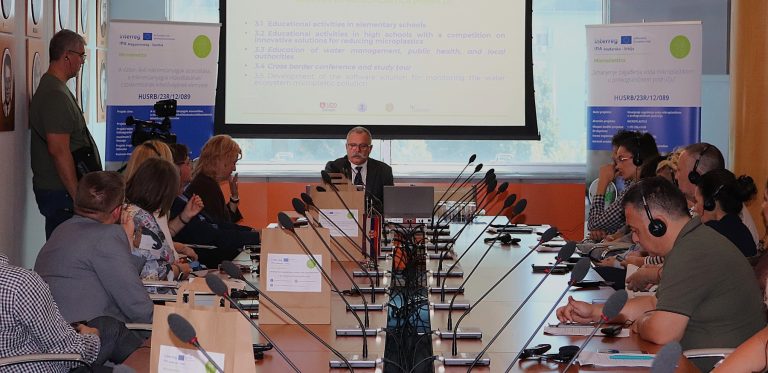
As part of the project “Reducing Water Pollution by Microplastics in the Cross-Border Area – MICROPLASTICS”, the Fund for European Affairs and Development of the APV implemented educational activities on the topic of the presence of microplastics in our environment, in which the elementary schools “Nikola Tesla” from Novi Sad, “Desanka Maksimović” from Bačka Palanka and “Avram Mrazović” from Sombor participated, as well as the secondary schools “Pavle Savić” from Novi Sad, “20. Oktobar” from Bačka Palanka and the Gymnasium “Veljko Petrović” from Sombor.
On this occasion, the students found out where in our environment microplastics can be found, and whether we can replace the everyday plastic we use with other, healthier materials. In accordance with the target group, in addition to the theoretical part, the lectures were also interactive, so high school students had the opportunity, among other things, to see worms that feed on Styrofoam without it negatively affecting their health, while elementary school students chose different objects and, through conversations with educators, determined whether they contained plastic or not.
The second part of the activity included a competition, the awarding of vouchers and gifts. High school students were tasked with modifying an existing plastic product of their own choice, improving it by using environmentally friendly materials and presenting their work through a presentation.
First place was won by the Pavle Savić Secondary Technical School from Novi Sad with the idea Eco Insoles. Second place went to the Veljko Petrović High School from Sombor for the idea Packaging made of banana, corn and hemp. Third place was won by the 20. oktobar High School from Bačka Palanka with the idea Filter for washing machines. Members of the project team on behalf of the Fund for European Affairs and Development of the APV distributed vouchers to secondary schools, and elementary school students who created collages from plastic were given promotional materials from the project.
The educational activities within the project showed that students approach the topic of microplastics with great knowledge, curiosity and creativity. Their ideas and participation in the competition contributed to highlighting the importance of environmental conservation in an interesting and practical way.